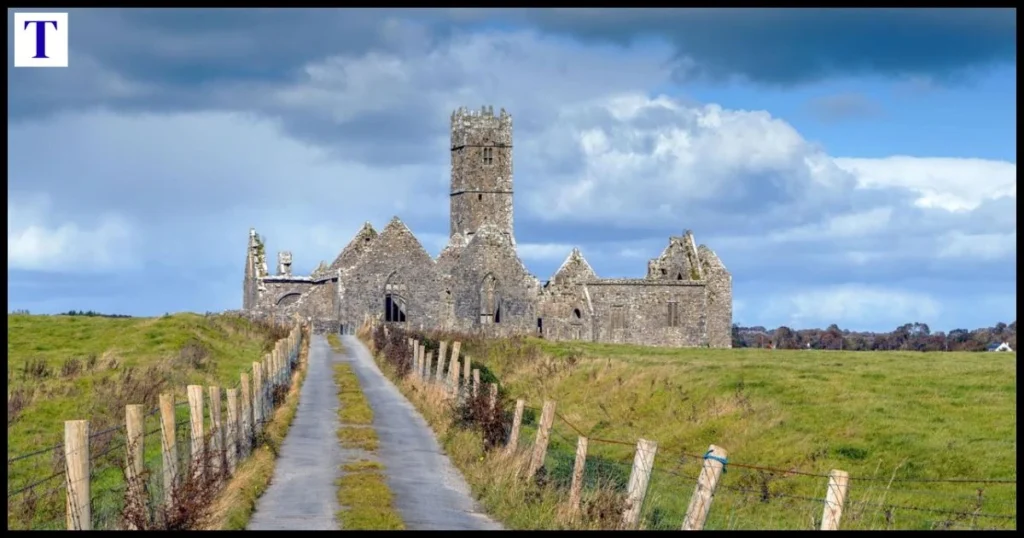

Ross Errilly Friary Ireland is one of the most impressive surviving Franciscan monastic sites in County Galway. Standing beside the Black River near Headford, this remarkable medieval complex gives visitors something that many ruined monasteries cannot: a strong sense of the original community and how its different spaces worked together. The church, bell tower, cloisters and domestic buildings remain substantial enough to make the layout understandable, while features such as the kitchen, oven, bake house, refectory and fish tank provide unusual evidence of everyday life. Heritage Ireland describes Ross Errilly as one of Ireland’s best-preserved and most complete ecclesiastical settlements.
Today, the friary is a National Monument cared for by the Office of Public Works. It is an unguided site in a peaceful rural setting, making it particularly appealing to visitors interested in Irish history, medieval architecture, photography and less commercial attractions.
Location and Setting Near Headford
Ross Errilly Friary is located beside the Black River, approximately 2 kilometres from Headford in County Galway. Its position in the countryside gives the ruins a distinctive atmosphere, with open green surroundings contrasting with the weathered stone of the medieval buildings. The Black River was also historically significant as part of the landscape around the Galway and Mayo area.
The location makes the friary relatively easy to include in a wider County Galway itinerary. It is close enough to Headford for a short heritage stop but secluded enough to feel removed from busy tourist areas. The approach is via a narrow road, and Heritage Ireland notes that access is through a gate over a cattle grid. There is a car park at the site, but visitors should drive carefully and allow extra time for the final approach.
The History of Ross Errilly Friary
The foundation date of Ross Errilly has been debated for many years. Heritage Ireland describes the friary as established in the mid-fourteenth century, while specialist Franciscan research argues that around 1460 is the most probable foundation date. The earliest surviving contemporary reference is from 1469, when Galway citizen John Blake left money to the friary in his will. This difference between sources is worth recognising because the history of the site is more complex than a single universally accepted foundation year.
The Franciscan community later adopted the Observant reform and became an important foundation in Ireland. The friary was officially dissolved during the suppression of monasteries in the sixteenth century, but the Franciscans returned several times, supported especially by the powerful Clanricarde family. The community endured periods of expulsion, military occupation and destruction before eventually leaving the site. Heritage Ireland records that Cromwell’s soldiers desecrated the friary in 1656, while Franciscan sources document further disruption before the buildings gradually fell into their present ruined state.
Medieval Architecture and Friary Layout
The architecture is one of the main reasons Ross Errilly is so valuable. Rather than surviving as a single church surrounded by fragments, the complex retains a recognisable arrangement of religious and domestic buildings. Two central cloister areas organise much of the site, while the church and bell tower occupy one side and the domestic ranges occupy another. This surviving layout helps visitors understand how a medieval friary functioned as an enclosed community.
Much of the visible fabric developed over several generations, reflecting the changing needs of the Franciscan community. A tower was constructed in 1498, while other additions created more space for worship and accommodation. The surviving architecture includes substantial stone walls, arches, chapels and internal divisions that demonstrate the scale of the complex. The unusually complete domestic ranges are especially important because they allow the site to be studied as both a religious monument and a place where people ate, slept, worked and carried out daily responsibilities.
Church, Cloisters and Tower
The church provides the central religious focus of the friary and contains several architectural features that reveal how the Franciscans used the building. The nave was a place where the local population could gather for Mass and sermons, while secondary altars and chapels supported additional forms of worship. The tower and later architectural additions changed the original layout as the friary developed.
The cloisters are equally important because they help visitors understand the organisation of the entire complex. Rather than being decorative courtyards alone, cloisters formed important circulation spaces connecting different parts of a religious community. At Ross Errilly, the existence of two cloister areas reflects the growth and complexity of the friary. Looking carefully at these spaces can make a visit much more rewarding: instead of seeing disconnected ruins, you can follow the relationships between the church, courtyards, domestic buildings and upper-level accommodation.
Daily Life Inside the Friary
Life at Ross Errilly involved much more than prayer. Like any sizeable medieval religious community, the friars needed places to prepare food, eat, sleep, store supplies and manage their daily responsibilities. The surviving domestic buildings provide rare physical evidence of this practical side of Franciscan life. Heritage Ireland specifically identifies the kitchen, oven, water tank for live fish, bake house and refectory among the site’s surviving features.
The upper levels were used for accommodation, while the lower areas supported communal and practical activities. These remains help explain how the friary could operate as a self-contained settlement. For modern visitors, this is one of the most interesting aspects of Ross Errilly because the ruins reveal ordinary routines that are often missing from traditional accounts of medieval religious history. The building itself becomes evidence: a fireplace suggests cooking, a refectory indicates communal meals, and the dormitory spaces show how the community was accommodated.
The Kitchen, Refectory and Fish Tank
The domestic features make Ross Errilly particularly distinctive. The kitchen contained an oven and a water tank designed for keeping live fish, while a bake house and refectory supported food preparation and communal dining. These features demonstrate the practical planning required to feed a religious community and show that the friary was a functioning settlement rather than simply a place of worship.
For visitors, these details are worth seeking out because they provide a more relatable connection with the people who lived here. A church can communicate religious beliefs, but a kitchen tells you something about everyday survival. The fish tank is especially memorable because it gives a physical example of food management within the community. When exploring the ruins, paying attention to these less obvious spaces can therefore reveal just as much about medieval life as the grander church and tower.
Ross Errilly During Ireland’s Religious Conflicts
The friary’s history was deeply affected by the religious and political upheavals that transformed Ireland from the sixteenth century onwards. During the suppression of monasteries under Henry VIII, Ross Errilly was confiscated by the Crown. Despite the formal dissolution, the Franciscans did not simply disappear from the area. Local protection, particularly from the Clanricarde Burkes, enabled the community to return at different points.
The following centuries brought further instability. Franciscan historical research records periods when English soldiers occupied the site, damaged the friary and destroyed community records and books. In 1656, Cromwellian soldiers desecrated the site while searching for valuables, according to Heritage Ireland. Later restrictions again forced the Franciscans away, although they returned in 1715 and remained for several decades. These events help explain why the surviving ruins carry such a complicated history rather than representing a simple story of abandonment.
Why Ross Errilly Friary Is Historically Important
Ross Errilly is important because it preserves an unusually complete picture of a Franciscan religious settlement. Its value goes beyond the surviving church. The combination of worship spaces, cloisters, accommodation and domestic facilities allows historians and visitors to understand how religious life was connected to everyday work. Heritage Ireland specifically describes it as one of Ireland’s best-preserved and complete ecclesiastical settlements.
The site also demonstrates how medieval buildings changed over time. Additions to the church, the later tower and the expansion of the domestic areas show that the friary was not static. It developed as the needs of the community changed. For anyone interested in medieval Ireland, this makes Ross Errilly particularly useful because the ruins can be read on several levels: as religious architecture, as evidence of social history, as a record of political upheaval and as an example of how communities adapted historic buildings over generations.
What Makes Ross Errilly Different from Other Irish Ruins?
Many historic Irish sites retain only a church, tower or section of wall, leaving visitors to reconstruct the original layout in their imagination. Ross Errilly offers a stronger sense of completeness because several major parts of the settlement survive together. The two cloisters, church, bell tower and domestic ranges make it possible to understand the relationship between different areas of the friary.
Its domestic survival is particularly valuable. Features such as the kitchen, bake house, refectory and fish tank provide evidence of practical life that is rarely as visible at ruined religious sites. This gives Ross Errilly a broader appeal than its name might suggest. A visitor interested in architecture can study the structure, a history enthusiast can explore its turbulent past, and someone simply curious about medieval living can examine the spaces where food was prepared, meals were eaten and people lived. The quiet landscape adds another layer to the experience.
Benefits of Visiting Ross Errilly Friary
A visit offers genuine educational value because the buildings make medieval history easier to visualise. Instead of reading about Franciscan communities in abstract terms, visitors can stand inside the spaces where religious ceremonies, communal meals and daily work once took place. The combination of sacred and domestic architecture is particularly useful for understanding how a medieval friary operated.
There are practical benefits too. The site is currently an unguided National Monument with access during daylight hours, and Heritage Ireland lists a car park. This means visitors can explore independently without having to fit their visit around a scheduled guided tour.
Key reasons to include it in a Galway itinerary include:
- Historical depth: Centuries of Franciscan and Irish history are visible in the ruins.
- Architecture: The church, tower, cloisters and domestic ranges offer plenty to examine.
- Authentic atmosphere: The rural setting is peaceful and relatively removed from busy tourist centres.
- Photography: Weathered stone, arches, courtyards and surrounding countryside create strong visual interest.
- Independent exploration: Visitors can take their time and focus on the areas that interest them most.
- Educational value: The surviving domestic spaces make medieval daily life easier to understand.
Visitor Experience and What to Expect
Ross Errilly is an unguided historic site, so the experience is different from visiting a large museum or staffed castle. There are no modern entertainment features to distract from the ruins. The attraction is the architecture, the atmosphere and the opportunity to explore a remarkably preserved medieval complex at your own pace. Heritage Ireland currently states that access is available during daylight hours.
A visit can be relatively short, but allowing enough time to walk around the different parts of the complex will make the experience considerably better. Discover Ireland recommends planning for up to an hour, while visitors with a strong interest in architecture or photography may naturally want longer.The site is best explored slowly: examine the church, follow the cloister, look into the domestic ranges and notice practical features that could easily be missed during a quick stop.
Practical Tips for Exploring the Ruins
A little preparation can make the visit more comfortable. The friary is reached by a narrow road, and Heritage Ireland notes that access is through a gate over a cattle grid. Parking is available, but the approach is not designed like a large modern tourist attraction. Visitors should drive carefully and take particular care around historic surfaces and structures.
Because the site is unguided and outdoors, comfortable footwear and sensible clothing are useful. Weather can change quickly in County Galway, so it is worth checking conditions before setting out. The official guidance also stresses the need for care and caution at unguided heritage sites. For photography, cloudy conditions can bring out detail in the stonework, while brighter weather can make the wider landscape easier to appreciate. Most importantly, avoid climbing or touching vulnerable historic features and follow any instructions displayed at the monument.
Why Ross Errilly Friary Is Worth Visiting
Ross Errilly is worth visiting because it provides a depth of historical experience that is unusual for a ruined monument. You can see the remains of a working Franciscan community rather than only the shell of a former church. The church, cloisters, tower and domestic buildings work together to tell a story about religion, architecture and ordinary life.
It is especially suitable for travellers who enjoy quiet historical places and independent exploration. The nearby Headford location makes it practical to add to a wider County Galway trip, while the rural surroundings give the visit an atmospheric quality. It may not suit visitors searching for interactive exhibitions, restaurants or extensive visitor facilities, but that is not really its purpose. Ross Errilly’s strength is authenticity. The stone buildings themselves are the experience, and for anyone interested in Ireland’s medieval past, that makes the site considerably more rewarding than a simple photograph stop.
(FAQs)
Where is Ross Errilly Friary located?
Ross Errilly Friary is located beside the Black River near Headford in County Galway, Ireland, about 2 kilometres north-west of Headford. Its peaceful countryside setting makes it a worthwhile historical stop for visitors exploring the Galway area.
When was Ross Errilly Friary founded?
The exact foundation date is uncertain. Heritage Ireland places its establishment in the mid-fourteenth century, while specialist research suggests that around 1460 may be more likely. The earliest known contemporary reference dates to 1469.
Who lived at Ross Errilly Friary?
Ross Errilly Friary was home to Franciscan friars. The community used the church and cloisters for religious activities, while the domestic buildings provided spaces for cooking, dining, sleeping and other aspects of everyday life.
What can you see at Ross Errilly Friary?
Visitors can explore the remains of the medieval church, bell tower, cloisters, chapels and domestic buildings. Notable surviving features include the kitchen, oven, bake house, refectory and fish tank, which provide insight into both religious and everyday life at the friary.
Is Ross Errilly Friary free to visit?
Yes, Ross Errilly Friary is currently a free-to-visit, unguided heritage site with access during daylight hours. A car park is available, making it relatively convenient for visitors travelling by car.
Conclusion
Ross Errilly Friary Ireland is one of those historic places where the surviving buildings make the past unusually easy to imagine. Its importance comes not from one spectacular feature but from the combination of the church, tower, cloisters and domestic ranges that remain together. The kitchen, bake house, refectory and fish tank are especially valuable because they reveal the practical side of life within a medieval Franciscan community.
Its complicated history adds even more depth. The friary survived religious suppression, political conflict, military occupation and repeated periods of Franciscan departure before eventually becoming the atmospheric ruin seen today. Its peaceful setting near Headford provides a fitting contrast to that turbulent past. For visitors interested in medieval architecture, Irish heritage, Franciscan history or authentic countryside attractions, Ross Errilly offers a meaningful experience without needing elaborate modern facilities. It is absolutely worth adding to a County Galway itinerary, particularly if you want to see one of Ireland’s most complete surviving Franciscan foundations.