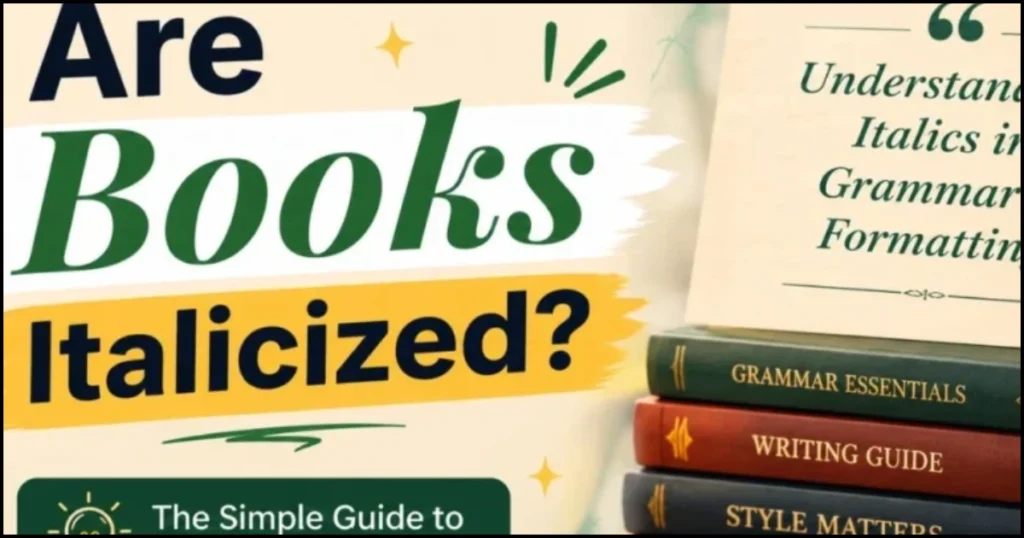

If you are writing an essay, assignment, article, book review or even a social media post, you may wonder whether book titles should be italicized, placed in quotation marks or underlined. The general rule is simple: complete book titles are usually italicized in modern English writing. However, the correct format can depend on the writing style you are following and whether you are referring to a complete book or a shorter work within it. MLA, APA and Chicago all have rules for formatting titles, and small differences can matter in academic writing. Knowing when to use italics, quotation marks and capitalisation correctly makes your writing clearer and more professional. This guide explains the rules in simple terms, with practical examples covering sentences, MLA, APA, Chicago, foreign-language books and common title-formatting mistakes.
Are Books Italicized?
Yes, complete book titles are generally italicized in standard English writing. This applies to novels, biographies, autobiographies, memoirs, textbooks, anthologies and other books published as complete, independent works. For example, you would normally write Pride and Prejudice, The Great Gatsby and Harry Potter and the Philosopher’s Stone. Italics help readers recognise that these words represent the title of a published work rather than ordinary words in the sentence.
The most useful rule is to distinguish between a complete work and a smaller part of a work. A complete book normally uses italics, while a chapter, article, poem or short story is generally placed in quotation marks. This principle applies across many common writing situations, although individual style guides have additional requirements. Once you understand this basic distinction, deciding how to format most titles becomes much easier.
Are Book Titles Italicized or Underlined?
In modern writing, book titles are normally italicized rather than underlined. Underlining was more common when people used typewriters because traditional typewriters did not provide an easy way to produce italic text. Today, word processors and publishing platforms make italics simple to use, so they have become the standard choice for book titles.
For example, write The Lord of the Rings rather than underlining the title in a digital document. This is also helpful online because underlined text can look like a hyperlink. If your teacher, university, publisher or employer specifically tells you to underline titles, follow those instructions. Otherwise, italics are normally the clearest and most modern option. A book title and its subtitle should also be treated as one complete title when applying the formatting rule.
Are Books Italicized in a Sentence?
Yes. A book title remains italicized when it appears within a sentence. Its position does not change the formatting rule. For example, you could write, “I recently finished The Hobbit,” or “The Hobbit remains a popular fantasy novel.” In both examples, the book title is clearly separated from the ordinary text through italics.
Normal grammar and punctuation still apply around the title. If a book title contains its own question mark or exclamation mark, that punctuation is part of the title. If the sentence requires additional punctuation, use the punctuation required by the sentence. The important point is that you should not remove the italics simply because the title appears in the middle of a sentence. Treat the book title as a distinct name while allowing the surrounding sentence to follow normal grammatical rules.
Should Book Titles Be Italicized or Put in Quotes?
Complete book titles are generally italicized, while shorter works are normally placed in quotation marks. This distinction is one of the easiest ways to avoid title-formatting mistakes. A novel such as Jane Eyre is a complete work, whereas a chapter or short story within a larger publication is a smaller work.
The difference can be remembered with these examples:
| Type of Work | Correct Formatting | Example |
|---|---|---|
| Book | Italics | Jane Eyre |
| Novel | Italics | The Great Gatsby |
| Chapter | Quotation marks | “The Opening Chapter” |
| Short story | Quotation marks | “The Tell-Tale Heart” |
| Poem | Quotation marks | “The Raven” |
| Article | Quotation marks | “Article Title” |
| Collection | Italics | Complete Stories |
Quotation marks are therefore not simply an alternative to italics. They communicate that the work is normally a smaller part of something larger. Once you identify whether you are referring to a standalone publication or a shorter work contained within another publication, the correct formatting becomes much clearer.
Are Books Italicized in MLA Style?
Yes. MLA style generally uses italics for the titles of complete books. This applies when a book is mentioned in the main text of an essay and when the title is included in a Works Cited entry. MLA also distinguishes complete works from smaller works, so chapters, poems, short stories and articles are generally presented differently.
MLA also has specific capitalisation rules for titles. Important words are normally capitalized in a book title, giving examples such as The Catcher in the Rye and To Kill a Mockingbird. The title and subtitle of a book are treated as part of the same complete work. If you are preparing an MLA assignment, remember that formatting the title correctly is only one part of the requirements. The author, publication information, in-text citation and Works Cited entry must also follow MLA rules.
Are Books Italicized in APA Style?
APA style generally italicizes book titles when complete books are discussed as works. However, APA can become confusing because the formatting and capitalisation of a title may differ depending on where it appears. A title mentioned in the text and a title appearing in an APA reference entry are not necessarily capitalized in exactly the same way.
In an APA reference list, a book title is italicized and normally uses sentence case. This means the first word, the first word after a colon or dash, and proper nouns are capitalized rather than every major word. Therefore, writers should not simply copy a title using standard title case into an APA reference. If your work requires APA style, check the complete reference format as well as the title itself.
Are Books Italicized in Chicago Style?
Chicago style generally uses italics for titles of books and other substantial, independently published works. Novels, biographies, memoirs and many other standalone publications are therefore normally italicized when their titles are mentioned. A title such as The Old Man and the Sea would typically appear in italics.
Chicago also distinguishes between complete works and shorter works. A chapter, article or short story within a larger publication is generally formatted differently from the book containing it. This follows the same broad principle used by several other major style systems. However, Chicago has detailed rules covering different publishing and citation situations, so formal academic or professional writing should follow the specific Chicago requirements being used rather than relying on a general rule alone.
How Are Book Titles Formatted in Different Styles?
The basic approach is similar across several major style systems, but capitalisation and citation details can differ. Understanding these differences is particularly important for students because using the correct style involves more than simply adding italics.
| Style | Book titles | Key point |
|---|---|---|
| MLA | Italicized | Title case is generally used |
| APA | Italicized | Reference-list titles use sentence case |
| Chicago | Italicized | Title case is commonly used |
| AP | Usually quotation marks | Journalism follows different title conventions |
If your school, university or publication specifies a style, follow that system consistently. Do not combine the capitalisation rules of one style with the citation rules of another. The general idea that complete books use italics is useful, but the surrounding requirements can change depending on the style guide.
What Are Common Mistakes When Formatting Book Titles?
Many title-formatting errors happen because writers use the same treatment for every type of work. The easiest way to avoid this is to identify the type of work before deciding how its title should appear.
Common mistakes include:
- Putting a complete book in quotation marks: Full books normally use italics.
- Underlining a book title unnecessarily: Modern digital writing normally favours italics.
- Italicizing every title: Chapters, poems and articles generally use quotation marks.
- Using incorrect capitalisation: MLA, APA and Chicago have different requirements.
- Mixing style guides: Choose the style required for your assignment or publication.
- Italicizing a character’s name: A character’s name is not automatically a book title.
- Forgetting the subtitle: A subtitle normally forms part of the complete book title.
The best approach is to pause and ask what you are actually naming. Is it a complete book, a chapter, a poem, an article or a person? Once that is clear, the appropriate formatting is usually much easier to choose.
Does Harry Potter Need to Be Italicized?
It depends on whether you are referring to the book or the character. When you mean a specific book, the complete title should normally be italicized. For example, Harry Potter and the Philosopher’s Stone is a book title, so it is formatted in italics.
However, “Harry Potter” can also refer to the fictional character. In a sentence such as “Harry Potter is a fictional wizard,” the words refer to the character rather than the book title, so they remain in normal text. This is an important distinction because the same name can appear in different contexts. Always consider what the words represent before applying formatting. A character’s name, author’s name or place name does not need italics simply because it is connected with a book.
Do You Italicize Foreign Book Titles?
Yes, foreign-language book titles are generally italicized when they refer to complete books. A French, Spanish, German or Italian novel is still a complete published work, so its title is normally treated like an English-language book title.
Translations can require additional care. In academic or professional writing, you may sometimes need to provide an English translation alongside the original title so readers understand what the work is. The exact treatment depends on the style guide and the purpose of your writing. You should not automatically put a foreign title in quotation marks simply because it is unfamiliar or written in another language. The type of work remains the most important factor. For a complete foreign-language book, italics are normally the appropriate starting point.
When Should You Not Italicize a Book Title?
Not every phrase associated with a book should automatically be italicized. If the words refer to a character, person, organisation or another name rather than the publication itself, normal formatting may be appropriate. For example, “Harry Potter” is not italicized when it refers to the character rather than a book.
There are also special cases involving religious works, laws, series names, titles within titles and other specialised categories. Different style guides may handle these differently. This is why it is better to understand the underlying principle instead of trying to memorise one rule for every possible title. First identify the type of work or name, then consider the writing style you are following. This method reduces mistakes and helps you deal with unusual examples more confidently.
(FAQs)
Do books need to be in italics?
Yes, complete book titles are generally italicized in standard English writing. This includes novels, biographies, memoirs, textbooks and other standalone books. The exact presentation can vary in certain specialised styles, so always follow specific instructions when they are provided.
Are books italicized or quoted in APA?
Book titles are generally italicized in APA. However, APA uses sentence case for book titles in reference-list entries, so the capitalisation can look different from the way the title is normally written in running text.
Are books italicized in MLA?
Yes. MLA generally italicizes the titles of complete books. Shorter works, such as chapters, poems, short stories and articles, are generally treated differently and use quotation marks.
Are book titles italicized or underlined?
Modern writing normally uses italics for book titles rather than underlining. Underlining was more common in older typewritten documents. If a teacher, publisher or organisation specifically requests underlining, follow its instructions.
Is italic text harder to read?
Large amounts of italic text can be less comfortable to read than normal text, which is why italics should be used selectively. A short book title in italics is normally easy to recognise and does not create a significant readability problem.
Conclusion
Complete book titles are generally italicized in modern English writing. Whether you are mentioning a novel in an essay, discussing a biography in an article or reviewing a textbook, italics are normally the correct way to distinguish the book title from the surrounding text. Shorter works, such as chapters, poems, articles and short stories, generally use quotation marks instead.
The most useful rule is to identify what type of work you are naming before deciding how to format it. Then check the style required for your specific purpose. MLA, APA and Chicago share the broad use of italics for complete books, but their capitalisation and citation requirements can differ.
Once you understand this simple distinction, book-title formatting becomes much easier. It takes only a few seconds to apply, yet it makes your writing clearer, more consistent and more professional.