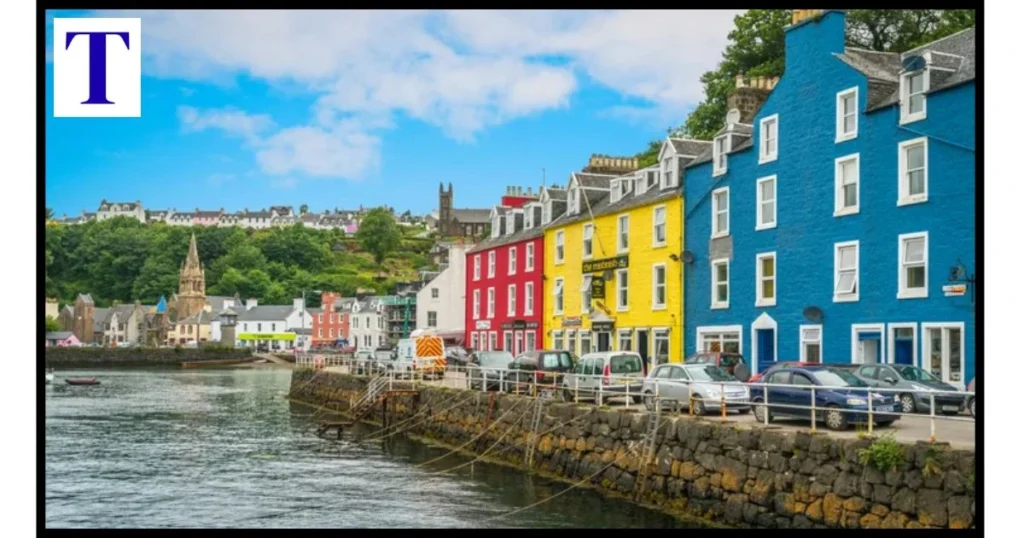

If you remember the colourful houses, harbour views and familiar characters from the BBC children’s series Balamory, you may still wonder where was Balamory filmed in real life. The answer is mainly Tobermory on the Isle of Mull in Scotland, a picturesque harbour town famous for its brightly painted waterfront buildings. These real streets, houses and coastal views became the setting for the fictional village seen throughout the original series. However, Tobermory was not the only location used by the production. Scenes were also filmed elsewhere in Scotland, including Glasgow and Fenton Tower near North Berwick. The programme returned to television in 2026, bringing renewed attention to its original Scottish filming locations and the real town behind the fictional village.
Where Was Balamory Filmed in Scotland?
The main filming location for Balamory was Tobermory on the Isle of Mull, in Scotland’s Inner Hebrides. The town’s colourful waterfront became one of the most recognisable features of the programme and helped create the impression of a cheerful island community. Unlike a television village constructed entirely on a studio backlot, much of Balamory’s outdoor setting came from genuine buildings and streets in Tobermory. This gave the programme a natural sense of place and allowed viewers to associate the fictional village with a real Scottish location.
Tobermory provided the production with an unusually distinctive combination of brightly coloured buildings, a sheltered harbour, boats, hills and coastal scenery. Several real properties were used to represent homes and workplaces belonging to the characters, while other parts of the town appeared as general village locations. Local tourism information confirms that Tobermory was the main filming location and continues to highlight the town’s connection with the programme. This is why anyone researching Balamory filming locations should begin with Tobermory rather than searching for a separate village called Balamory.
The main Tobermory filming environment included:
- Tobermory harbour: One of the most recognisable parts of the television setting.
- The colourful waterfront: The bright buildings helped establish Balamory’s visual identity.
- Main Street: Several locations connected with characters can be found around the town.
- Character houses: Real buildings were used as homes for several familiar characters.
- Local businesses: Some shops and other properties appeared as part of the fictional village.
- Surrounding scenery: Mull’s hills, coastline and countryside helped complete the setting.
Why Was Tobermory Chosen for Balamory?
Tobermory was a particularly strong choice because the town already looked visually distinctive before cameras arrived. Its waterfront contains rows of colourful buildings facing the harbour, while the surrounding hills and water create a recognisable Scottish island landscape. For a children’s television programme, these features were valuable because viewers could quickly identify the setting without needing elaborate explanations. The bright architecture also worked well with the programme’s colourful characters and cheerful visual style.
There were practical advantages as well. Using a real town meant the production could film outside homes, along streets and around the harbour while creating the feeling of a genuine community. Different buildings could represent different characters, giving each part of the fictional village its own identity. The combination of real locations and television production techniques made Balamory feel larger than a single studio set. Local information about the programme notes that the town’s businesses, attractions and community were involved in supporting the production.
Where Are the Famous Balamory Houses?
The Balamory houses are among the most searched-for locations because the brightly coloured buildings became closely associated with individual characters. In the programme, the colour and appearance of each property helped younger viewers identify who lived there. This made the houses more than simple backgrounds; they became part of the storytelling and helped establish the personality of the fictional village.
Many of the properties were genuine buildings in Tobermory, which means their history did not end when filming finished. Some are now used as accommodation or businesses, while others have different owners or purposes. Local Tobermory information explains that many of these properties are private and cannot simply be entered or toured by visitors. Fans can still appreciate the exteriors from suitable public areas, but it is important to remember that these are real properties rather than preserved television sets.
The best-known Balamory properties include:
- Spencer’s house: Associated with the artistic character played in the series.
- Miss Hoolie’s house: One of the colourful properties linked with the central character.
- PC Plum’s White House: Recognisable from the programme’s outdoor scenes.
- Josie Jump’s house: One of the locations frequently sought by visitors.
- Penny Pocket and Suzie Sweet’s shop: Another memorable character location.
- Edie McCredie’s former garage: A location that has since changed its use.
What Happened to Edie McCredie’s Garage?
Edie McCredie’s garage was another recognisable Balamory location and helped establish the fictional village as a place where people had everyday jobs and services. Edie’s character was associated with the garage, making the building an important part of the show’s visual world. Like many other Balamory locations, however, it was a real property rather than a permanent television set.
The building has changed since the programme was filmed. Local information identifies the former location with the Tobermory Chocolate Factory, showing how a television filming site can develop into a completely different local business. For visitors, this means the building may not immediately resemble the garage remembered from older episodes. Its connection with Balamory is nevertheless an interesting part of the town’s history.
This is also a useful reminder that filming-location tourism involves seeing places as they exist today. Television captures a building at a particular moment, but real businesses and properties naturally change over the years. For Balamory fans, comparing the modern building with old episodes can make the visit more interesting rather than less authentic.
Where Was Archie’s Castle Filmed?
Archie’s Castle is an important exception when answering where was Balamory filmed because its location was not in Tobermory. The exterior of Archie’s fictional home was filmed at Fenton Tower near North Berwick in East Lothian. This means that one of the most memorable buildings associated with the programme was actually located on the Scottish mainland, several hundred miles from the Isle of Mull.
Fenton Tower is a genuine historic fortified tower rather than a structure built specifically for Balamory. Its distinctive appearance made it suitable for representing Archie’s home and gave the character a memorable setting. Fenton Tower’s official information confirms its use as a filming location for the BBC programme. Today, the tower has a different role and is available as exclusive accommodation, so it should not be confused with a permanent Balamory visitor attraction.
The wider filming map therefore included:
- Tobermory: Main village and exterior filming location.
- Fenton Tower: Exterior location for Archie’s Castle.
- Glasgow: Nursery filming.
- Craignure: Former Mull Narrow Gauge Railway location.
- Other Mull locations: Additional island scenes.
Television editing brought these separate Scottish locations together so that they appeared to belong to one fictional village.
Where Was the Balamory Nursery Filmed?
The nursery scenes were another example of the production using locations outside Tobermory. Local information states that nursery shots were filmed in Glasgow, allowing the production to handle indoor scenes separately from the main exterior filming on the Isle of Mull. This approach is common in television because indoor scenes can often be produced more efficiently away from the main location.
For viewers, the distinction is easy to miss because editing makes the nursery appear naturally connected to the rest of Balamory. The audience is presented with one fictional community even though different scenes may have been filmed hundreds of miles apart. This combination of location work and indoor production helped the original series create a consistent world without needing every scene to be filmed in one place.
The original production therefore combined:
- Tobermory exterior scenes
- Glasgow nursery scenes
- Fenton Tower
- Other locations around Mull
- Interior and studio-style filming
This is why Tobermory is the main answer, but not the complete answer, when researching the programme’s filming history.
What Was the Mull Narrow Gauge Railway?
The Mull Narrow Gauge Railway was another memorable location connected with the series. The railway was situated near Craignure, where it connected the ferry area with Torosay Castle. It was used during the second series and gave the production another distinctive Isle of Mull setting. Its inclusion helped broaden the fictional world beyond Tobermory itself.
The railway is no longer operating today, which means visitors cannot experience it in the same way that viewers saw it in the programme. Local information explains that parts of the former railway route can still be walked, giving visitors an opportunity to explore some of the landscape associated with the old line. However, the working railway shown in the original series is part of the area’s past.
This makes the railway an interesting example of how filming locations can change over time. Some Balamory buildings are still active businesses or accommodation, while other locations have closed or been repurposed. Anyone planning a complete filming-location trip should therefore check current local information rather than relying only on scenes from old episodes.
Where Was Balamory Filmed for the 2026 Revival?
Interest in where was Balamory filmed increased again when the programme returned to CBeebies in 2026. The revival brought back familiar characters including Miss Hoolie while introducing new characters and stories for a new generation. Rather than abandoning the original setting completely, the new production maintained its connection with Tobermory.
The return to the real town is particularly significant because it connects the original series with the modern revival. Radio Times reported that Julie Wilson Nimmo, who plays Miss Hoolie, returned to Tobermory for filming and recreated elements associated with the original opening sequence. The production therefore uses the real Scottish town as an important visual link between the two generations of the programme.
The revival combines several elements:
- Returning original characters
- New Balamory characters
- Tobermory location filming
- Studio production
- Modern television techniques
- Familiar Scottish scenery
For viewers who remember the original programme, seeing Tobermory again provides a strong sense of continuity.
Is the New Balamory Filmed in the Same Places?
The 2026 revival keeps Tobermory closely connected with Balamory, but viewers should not expect every scene to have been filmed in exactly the same building used decades ago. Real properties naturally change, and modern television production also relies more heavily on controlled studio environments for certain scenes. The new series therefore combines real-world location filming with studio work.
The return to Tobermory nevertheless preserves the most important geographical connection. The town’s colourful waterfront remains the real-world backdrop associated with Balamory, while returning cast members add another layer of continuity. This allows longtime viewers to recognise the setting while giving the revived series enough flexibility to tell new stories.
For fans, the biggest similarity is the continued relationship between Balamory and Tobermory. The biggest difference is the way modern production techniques can combine location footage with studio environments to create the finished programme.
Can You Visit the Balamory Filming Locations?
Yes, visitors can still explore many of the recognisable Balamory locations in Tobermory. The colourful waterfront and harbour are the easiest places to start because they provide the overall setting that viewers immediately associate with the programme. Several character houses can also be identified around the town, making it possible to create a self-guided Balamory-themed walk.
However, Tobermory is not a dedicated Balamory theme park. Many of the buildings are private homes, hotels or working businesses, and local guidance makes clear that visitors cannot simply walk into the filming properties. The best approach is to enjoy the exteriors from public areas and treat the town as a normal residential and tourist community.
Visitors should:
- Stay on public streets and paths.
- View private properties from appropriate areas.
- Avoid entering gardens or restricted buildings.
- Keep entrances and walkways clear.
- Respect residents and hotel guests.
- Follow local signs and instructions.
This approach allows fans to enjoy the filming history without causing problems for the people who live and work there.
Is Tobermory Worth Visiting for Balamory Fans?
For people who grew up watching Balamory, Tobermory offers something that a recreated attraction cannot: it is the real place that became the visual foundation of the fictional village. Seeing the colourful buildings, harbour and streets in person can be particularly memorable when you recognise them from childhood television. The fact that the town remains a working community also gives the experience a sense of authenticity.
There are limitations, however. Tobermory is not a dedicated Balamory attraction, so visitors will not find a large theme park, recreated houses or an exhibition covering every episode. Some filming locations are private, some buildings have changed and the former railway is no longer operating. The experience is therefore best suited to visitors who want to see the real setting rather than an organised theme-park-style attraction.
Pros
- Authentic setting: You are visiting the real town used by the production.
- Colourful scenery: The waterfront remains visually distinctive.
- Nostalgic locations: Several familiar buildings can still be identified.
- Beautiful island environment: Mull offers much more than Balamory.
- Self-guided experience: Many locations can be explored while walking around town.
- Wider attractions: The trip can include other places and activities around Mull.
Cons
- No dedicated theme park: Balamory is not a purpose-built tourist attraction.
- Private buildings: Some famous locations cannot be entered.
- Changed properties: Some locations look different from the original episodes.
- Closed railway: The former Mull Narrow Gauge Railway no longer operates.
- Travel planning: Reaching the Isle of Mull requires additional planning.
For fans who value authenticity and nostalgia, the real Tobermory setting can still be well worth visiting.
How Should You Plan a Balamory Filming Location Trip?
Planning a trip to Tobermory requires more preparation than visiting an ordinary town because it is located on the Isle of Mull. Travellers from mainland Scotland generally need to use a ferry, and those taking a car should check current booking requirements before travelling. Ferry availability, accommodation and seasonal demand can all affect the ease of the journey, particularly during busy periods.
It is also sensible to allow flexibility in your itinerary. Scottish island weather can change quickly, and outdoor sightseeing may take longer than expected. Rather than trying to visit every filming location in a single rushed afternoon, allow time to enjoy Tobermory itself and explore other parts of Mull. Checking current transport and local business information before departure can help avoid unnecessary problems.
Before travelling, check:
- Current ferry timetables
- Vehicle booking requirements
- Accommodation availability
- Local business opening hours
- Weather forecasts
- Walking routes
- Current access restrictions
A flexible plan will usually provide a more enjoyable experience than a tightly packed schedule.
When Is the Best Time to Visit Tobermory?
Summer is often convenient for a Balamory-themed trip because longer daylight hours provide more time for walking around the waterfront and exploring the island. It is also the busiest tourist period, meaning accommodation and ferry services may be in higher demand. Anyone travelling during summer should consider making important bookings well in advance.
Spring and autumn can provide a quieter atmosphere and beautiful scenery, although the weather can be unpredictable. Winter is generally much quieter but may require additional planning because some businesses and visitor services operate differently outside the main tourist season. There is therefore no single perfect time for everyone; the best choice depends on your travel priorities and tolerance for changing weather.
For most visitors, the most important preparation is not simply choosing a month. Check the ferry schedule, accommodation availability and current local conditions before travelling, and take suitable clothing for outdoor sightseeing regardless of the season.
What Should Visitors Know Before Seeing Balamory Locations?
The most important thing to remember is that the Balamory filming locations are part of a real community. The colourful buildings may look like television sets, but many are homes, hotels, shops or other working properties. Visitors should therefore behave as they would in any residential area and avoid assuming that a building’s appearance on television gives them permission to enter.
Photography from public areas is generally the simplest way to enjoy the locations, provided that you do not obstruct entrances or disturb residents. If a building currently operates as a business, follow its access rules rather than relying on information from old television episodes or fan websites. Respectful filming-location tourism helps protect the relationship between visitors and local communities.
A considerate Balamory visitor should:
- Remain in public areas.
- Respect private property.
- Avoid trespassing.
- Keep noise levels reasonable.
- Do not block doorways or roads.
- Follow current local guidance.
- Respect residents, workers and guests.
The aim is to enjoy the history of Balamory while remembering that Tobermory is first and foremost a real Scottish community.
(FAQ’s)
1. Where ws Balamory filmed?
This is the main target question and should definitely stay.
2. Is Balamory a real village?
Important because many readers want to know whether Balamory actually exists.
3. Where was Archie’s Castle filmed?
A strong specific-location question that expands the article beyond Tobermory.
4. Can you visit the Balamory filming locations?
Very useful for visitor/travel intent and adds practical value.
5. Was Balamory filmed in Tobermory for the 2026 revival?
This adds fresh/current relevance and distinguishes your article from older Balamory location guides.
Conclusion
The main answer to where was Balamory filmed is Tobermory on the Isle of Mull in Scotland. Its colourful waterfront, harbour, streets and real buildings created the distinctive setting that made the fictional village instantly recognisable. Although Tobermory was the primary filming location, the production also used other Scottish locations, including Fenton Tower near North Berwick for Archie’s Castle and Glasgow for nursery scenes. The former Mull Narrow Gauge Railway near Craignure also appeared in the original series, making the filming history more extensive than one location alone.
Today, Tobermory remains the best place to experience the real-world setting behind Balamory. Visitors can explore the colourful harbour, identify familiar character buildings and enjoy the wider scenery of the Isle of Mull. Some filming locations are now private homes, hotels or businesses, so they should be viewed respectfully from public areas. The return of Balamory in 2026 has also renewed interest in Tobermory and its connection with one of Britain’s best-known children’s television programmes.